MJO · Connect guide · Claude Code
How to connect an MCP server to Claude Code
Claude Code adds a remote MCP server with one terminal command, claude mcp add --transport http, and signs in through the /mcp menu. Connectors you have already added on claude.ai can appear in Claude Code without any setup.
For MCP Journey Optimization, Claude Code is the shortest Install stage of any client: one line, pasted once. The comparison with every other client is in the field guide.
What you need
- Claude Code installed and signed in.
- The server address, e.g. for the CrushedWithIt server,
<your server URL>. - Anthropic's docs say HTTP is the recommended transport for remote servers and that SSE is deprecated.
Steps
- In your terminal, add the server:
If the provider gave you a key instead of a sign-in, add it as a header:claude mcp add --transport http crushedwithit <your server URL>--header "Authorization: Bearer your-token"(short form-H). - Choose where it is stored with
--scope:Scope Stored in Who can use it local(default)~/.claude.jsonYou, in the current project project.mcp.jsonin the project rootEveryone on the project, through version control user~/.claude.jsonYou, in every project - Start Claude Code and run
/mcp. Select the server and follow the browser steps to sign in. Anthropic says tokens are stored securely and refreshed automatically. From the shell,claude mcp login crushedwithitdoes the same. - Check it:
claude mcp listshows every server;claude mcp get crushedwithitshows one.
Already added it on claude.ai?
If you are signed in to Claude Code with a claude.ai account, Anthropic says connectors you added at claude.ai/customize/connectors appear in Claude Code automatically, marked as coming from claude.ai. They load only when your active login is a claude.ai subscription; if /mcp doesn't list one, run /status to check. See the Claude guide.
What it looks like (captured 26 Nov 2026)
The command, and the real status Claude Code reported for a project-scoped server in a fresh folder.
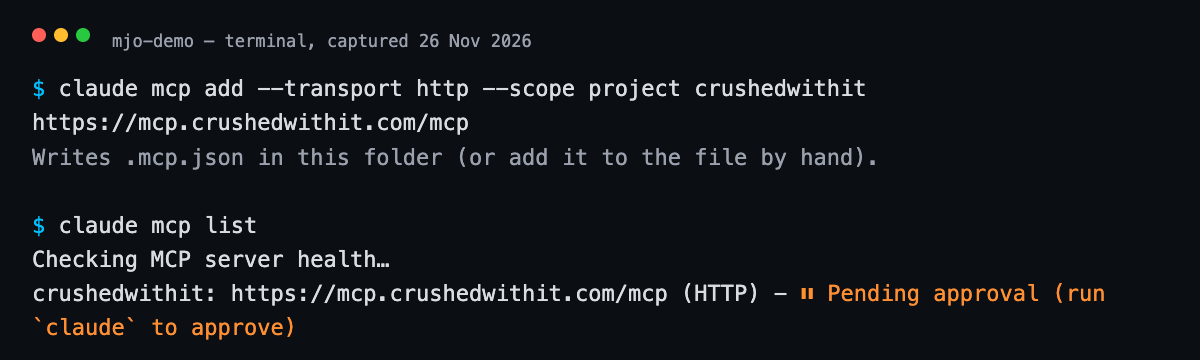
claude; then /mcp signs you in.Try it
Ask for something read-only. With the CrushedWithIt server as the example:
Use the crushedwithit tools to show my account and how many credits I can spend now.
For any server: "List the tools from <server name> and call the simplest read-only one." /mcp shows whether the server is connected if nothing happens.
Common errors and fixes
| What you see | Fix | Basis |
|---|---|---|
| "Incompatible auth server: does not support dynamic client registration" | The server needs pre-registered credentials. Register an OAuth app with the provider (redirect http://localhost:PORT/callback), then add with --client-id, --client-secret and --callback-port set to that port. | Claude Code docs |
| Server slow to start | Raise the startup timeout, e.g. MCP_TIMEOUT=10000 claude for 10 seconds. | Claude Code docs |
| Warning about large tool output | Claude Code warns above 10,000 tokens; the default maximum is 25,000. Raise it with MAX_MCP_OUTPUT_TOKENS, or ask the server for smaller results. | Claude Code docs |
| Project server not starting | Servers in .mcp.json need approval in interactive sessions. claude mcp reset-project-choices resets earlier choices. | Claude Code docs |
| Connector shows "session token rejected" | claude.ai rejected your Claude Code login token; authorising the connector again doesn't clear it. Follow the steps on Anthropic's errors page. | Claude Code docs |
| Server SSE-only | Use --transport sse. Anthropic says newer versions try HTTP first and fall back to SSE. | Claude Code docs |
How to disconnect
- Sign out first so the token is revoked:
claude mcp logout crushedwithit(or Clear authentication in the/mcpmenu). - Remove it:
claude mcp remove crushedwithit.
Anthropic notes that removing a remote server deletes its stored tokens locally but doesn't revoke them at the authorization server, which is why logout comes first.
Sources
- Claude Code docs: Connect Claude Code to tools via MCP, checked 26 Nov 2026.
- MCP authorization specification.
Other clients: the MCP field guide compares all ten. The framework: MCP Journey Optimization (MJO).